Tag: foreclosure-process

  • Understanding the Foreclosure Process in Ohio

    Understanding the foreclosure process in Ohio is an important part of navigating your own home foreclosure.

    Before we dive in…

    What is foreclosure anyway?

    Foreclosure is the legal process that lenders use to take back property securing a loan, generally after the borrower stops making payments.

    Foreclosure is no fun.  But just know that it’s not the end of the world.

    When you know how foreclosure in Ohio works… it arms you with the knowledge to make sure you navigate it well and come out the other end as well as possible.

    The Basic Stages of A Foreclosure

    There’s a few stages that are important to any foreclosure process.

    Foreclosure works differently in different states around the country.

    The two ways different states use to foreclose upon a property are: judicial sale or power of sale.

    Connect with us by calling

    or through our contact page to have us walk you through the specific foreclosure process here locally in Cincinnati & Dayton.

    In either scenario, foreclosure typically doesn’t go to court until 3-6 months of missed payments have elapsed. Usually (but not always), a lender will send out many notices that you are in arrears – overdue or behind in your payment.

    Under Judicial Foreclosure:

    • Your mortgage lender must file suit in the court system.
    • You’ll get a letter from the court demanding payment.
    • Assuming the loan is valid, you’ll have 30 days to bring payment to court to avoid foreclosure (and sometimes that can be extended).
    • If you don’t pay during the payment period, a judgment will be entered and the lender can request the sale of your property – usually through an auction.
    • Once the property is sold, the sheriff serves an eviction notice and forces you to immediately vacate the property.

    Under Power of Sale (or Non Judicial Foreclosure):

    • The mortgage lender serves you with papers demanding payment, and the courts are not required – although the process may be subject to judicial review.
    • After the established waiting period has elapsed, a deed of trust is drawn up and control of your property is transferred to a trustee.
    • The trustee can then sell your property for the lender at a public auction (notice must be given).

    Anyone who has an interest in the property must be notified during either type of foreclosure.

    For example, any contractors or banks with liens against a foreclosed property are entitled to collect from the proceedings of an auction.

    What Happens After A Foreclosure Auction?

    After a foreclosure is complete, the loan amount is paid off with the sale proceeds.

    Sometimes, if the sale of the property at auction isn’t enough to pay off the loan, a deficiency judgment can be issued against the borrower.

    A deficiency judgement is where the bank gets a judgement against you, the borrower, for the remaining funds owed to the bank on the loan amount after the foreclosure sale.


    Some states limit the amount owed in a deficiency judgment to the fair value of the property at the time of sale, while other states will allow the full loan amount to be assessed against the borrower.

    Here’s a great resource that lists the state by state deficiency judgement laws, since every state is different.

    Generally, it’s best to avoid a foreclosure auction. Instead, call up the bank, or work with a reputable real estate firm like us at Ohio Cash Buyers LLC to help you negotiate discounts off the amount owed to avoid having to carry out a foreclosure.

    Experienced investors can help you by negotiating directly with banks to lower the amount you owe in a sale – or even eliminate it, even if your home is worth less than you owe.

    If you need to sell a property near Cincinnati & Dayton, we can help you.

    We buy houses in Cincinnati & Dayton Ohio like yours from people who need to sell fast.

    Give us a call anytime or
    fill out the form on this website today! >>


    Other Foreclosure Resources For Cincinnati & Dayton Ohio HomeOwners:

  • What is a Pre-Foreclosure in Cincinnati & Dayton?

    With millions of homes across the country going into foreclosure, it’s important for both buyers and mortgage holders to understand the process.

    So what is a pre-foreclosure in Cincinnati & Dayton anyway?

    Many homeowners across America and Cincinnati & Dayton are facing difficulties making their monthly mortgage payments.

    When a homeowner misses 3-6 months of mortgage payments, the lending institution will issue a warning, notifying the homeowner to pay or lose their home. This period is known as “pre-foreclosure.”

    Banks and mortgage lenders typically provide three months for the homeowner to become current.  Of course this number can vary by bank and situation sometimes.

    If a homeowner fails to make the necessary payments, the bank will foreclose on the home, assuming ownership, and evict the homeowner. Thankfully, during this stage of the foreclosure process, a mortgage holder has the opportunity to take advantage of several options to prevent losing their home.

    Pre-foreclosure Options for Borrowers

    If you’re behind on mortgage payments, you’re likely to receive a “notice of default” from your mortgage lender.

    This document will state that you have not made mortgage payments for the last 90-180 days. It’s important not to panic.

    You have options that can delay or even prevent losing your home:

    • If your mortgage is “above water,” (meaning you have equity in your house) you may be able to refinance your mortgage, receiving lower monthly payments.  Check with your local Cincinnati & Dayton mortgage broker… or contact us and we can connect you with a reputable one.
    • You may be able to quickly sell your home to a real estate investor that’s reputable in Cincinnati & Dayton like us at Ohio Cash Buyers LLC, using the cash acquired to pay the months of back-payments owed (or we *may* be able to work out something with the lender that relieves all or part of your back payments.We can buy your Cincinnati & Dayton OH area home quickly, often in just a week or two, will pay in cash, and takes the stress out of trying to find a buyer.
    • You can contact the bank and ask them to permit a short sale. In a short sale, you’ll sell your home for less than it’s worth, and the bank will take the loss as a tax write-off.  In some short sales you may still be required to pay the difference to the bank if the house doesn’t sell for what is owed on the loan.
    • You may be able to declare bankruptcy, which can buy you time to pay your debt. Bankruptcy will remain on your credit report for years, and can cause significant damage.

    Lenders are very much aware of the widespread financial troubles across the country and they’re willing to work with borrowers a lot of the time.

    If you’re honest and communicate with your lender, you’ll often find that there are options that will allow you to remain in your home, or at least salvage your credit rating.

    A foreclosure can often negatively affect your credit score by 200-400 points and can prevent you from obtaining a loan of any sort for 5-7 years, so be very dutiful if you’ve received a Notice of Default from your lender.

    But if you’re not able to find a solution with your lender working directly with them… connect with us. We may be able to help.

    Ways We Can Help If You’re In Pre-Foreclosure

    • We can potentially help with a short sale – Submit your info on this website so we can evaluate your situation to see if we can help.
    • We can buy your Cincinnati & Dayton area house – We buy houses in Cincinnati & Dayton and would love to make you an all-cash offer on your house too. Just fill out the form here to get started >>
    • You can ask us questions and we can provide you FREE guidance and resources so you can make a well educated decision. This costs you nothing, there’s absolutely no pressure, no obligation… just free guidance without a catch.

    If you’re in the pre-foreclosure stage… you’ve still got time to fix this situation.

    Just connect with your bank to see if they’re willing to work with you… or contact us if you’d like to see what we can buy your house for or to tap into our free foreclosure foreclosure resources.

    Want To Discuss Your Pre-Foreclosure Options? Call Us at
    Or, Submit Your Info Here To Get A Cash Offer On Your House >>

  • Why Do We Pay Property Taxes?

    Whether you’re a seasoned homeowner, or someone on the hunt for your very first home, you should know what Property Taxes are and why everyone who owns real estate has to pay them.  Read on to find out what can happen if you don’t pay your Property Taxes on time.

    If you’ve been renting for a long time, it might come as a surprise to you that Property Taxes are a fairly significant constant and recurring expense that you need to factor in when on the hunt for your first home purchase. On the flipside, if you’re a landlord, you know very well how much you’re spending per month on Property Taxes on any of your properties. 

    Note to renters: Yes, some landlords may be greedy, and inflate your rent amount each year by much more than is reasonable; however, keep in mind that the costs for owning and maintaining housing rise every year with the normal pace of inflation, AND often experience small spikes due to local tax adjustments or special assessments. Most landlords are just trying to keep up with the bills.

    Taxes, as a whole, serve to fund various parts of society that are public services rather than private businesses. Since these various services don’t have a traditional business structure with a stream of revenue from selling goods or services, the public provides that source of revenue directly via various taxes. Essentially, when you pay a tax, you’re paying to keep your city, county, state, and country up and running. There are a variety of taxes that are charged against many different types of transactions and circumstances, which you can easily see an example of if you look at the bottom of your receipt from the department store (sales tax). 

    Learn More About How Our Process Works!

    What’s interesting about city, county, and state taxes, is that they can vary wildly from one place to the next. This is due to the different needs each place has, and what each population deems most important. You might find that a particular city has much higher sales or income taxes than its neighbor, because the city has allocated more funding in its budget towards infrastructure maintenance, or towards keeping the main public areas of the city extremely clean and well-manicured with fresh landscaping throughout the year.

    Property taxes are used to fund a host of local public needs, including the fire department, police department, libraries, road construction and maintenance, the local school district, and much more. They serve as a vital source of funding to keep these services alive, and when revenue dips, those services may suffer as a result. Cities may struggle with making decisions on their budgets each year if that happens, and may be forced to make tough choices in reducing access to essential public services. If you’ve ever heard of schools not being able to afford enough supplies for their students, or about them cutting bus routes out, it’s often because they aren’t receiving enough public funding to pay for everything and everyone that they need.

    How is the Property Tax on your home calculated?

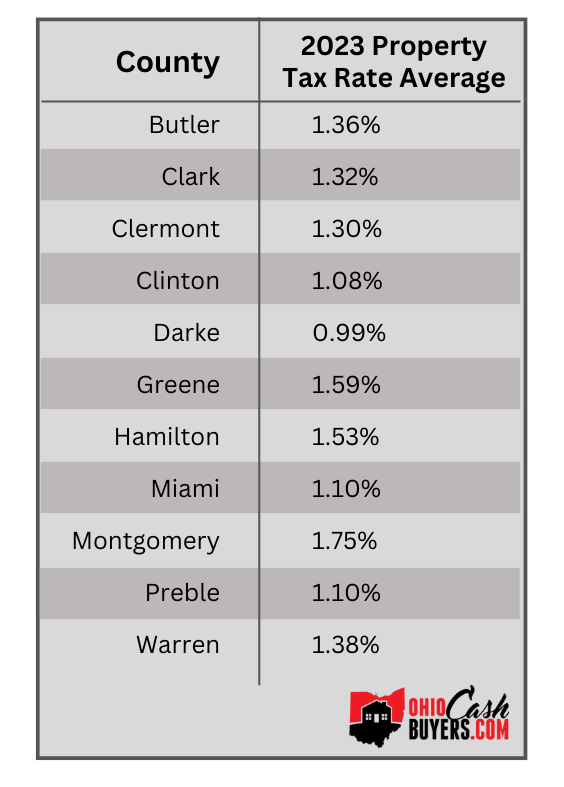
    The County dispatches a specialized tax assessor to determine the fair and current market value of your home (usually this happens every couple of years, unless a purchase/sale of the home is completed to trigger a more immediate request for an updated value assessment). Once the value has been determined, the County is then able to assess Property Taxes against that value as a percentage. As mentioned earlier, the tax rate varies from one County to the next.

    Let’s take a look at the Counties we regularly buy houses from to better show you some differences:

    If you live somewhere in Dayton (anywhere in the metro area that falls within Montgomery County), you’re looking at a much higher Property Tax Rate than the rest of Southwestern Ohio.

    So what happens if you cannot pay your Property Taxes?

    Life happens sometimes, and you can fall behind on paying your taxes. At this point, the home is placed in a “Delinquent Taxes” status, and the County attempts to collect payment from you, with penalties and late fees added on top of your original bill. There is a window of time that you can pay these past due property taxes off and remain in good standing with the County (one calendar year). 

    However, once that window of time has passed, you will lose all rights to your home, and it will be sold out from underneath of you to satisfy the tax debt. Don’t let that happen to you! If you’re behind on paying your Property Taxes and it’s possible that you won’t get caught back up on them, you need to call us NOW to discuss your options to sell your home and avoid foreclosure. Even if you’re just seeking some information and you don’t seriously think you’ll need to sell your home, you should definitely still talk to us. We have a wealth of knowledge and experience in these situations, and we’re happy to help in any way that we can, whether we buy your house or not.

    Call Now! 513-815-5000