Tag: foreclosure

  • Can I sell my Cincinnati & Dayton house in foreclosure?

    Do you have a Cincinnati & Dayton Ohio house that’s in foreclosure right now? Many people going through the Ohio foreclosure process want to get out from under that burdensome house and wonder if they can sell the house in foreclosure. The short answer: yes. The long answer: it’s a little more complicated, but usually you can sell your property prior to foreclosure. Generally, the sooner you start, the better.

    Selling Your Cincinnati & Dayton House In Foreclosure – How it works

    There are a lot of folks in Cincinnati & Dayton who have faced foreclosure in the past few years. Since the changes in the economy, a lot of banks have been shifting the way that they deal with foreclosures.
    Remember, the bank that carries your mortgage doesn’t want to see your home abandoned or auctioned. The bank stands to make the most amount of money by helping you to avoid foreclosure by selling your property. However, dealing with banks during any part of the foreclosure process can be a huge pain. Over many years of working with banks to help stop the foreclosure process, we’ve learned a few tricks that will help you.

    Working With Banks During The Foreclosure Process

    1. Always over-communicate with the bank (but don’t be annoying). Call with updates and show them what you’re doing to get your property sold.
    2. Don’t miss deadlines. If anything will be late, call with advance notice.
    3. Remember that bankers are people too. Don’t be overly dramatic, but explaining your situation and demonstrating your willingness to fix the problems to make it right goes a long way.
    4. Start keeping careful records of every conversation you have with the bank. Nothing counts unless it is in writing. Make sure to keep track of each person you speak with, what they said, and any promises made.
    5. Explore all your options, including short sale, loan modifications, and bankruptcy. Depending on the details of your personal situation, you may be able to dramatically slow down the foreclosure process with enough effort. Each bank has its own policies to help borrowers avoid foreclosure.
    6. Don’t wait. Unfortunately, time is not on your side. The further behind you become on payments, the less options are available to you.

    If you’re looking to sell your Cincinnati & Dayton house in foreclosure fast, call us now.

    We specialize in helping homeowners in situations including foreclosure around Cincinnati & Dayton and the whole state of Ohio get out of difficult situations and avoid foreclosure. In certain circumstances we can negotiate directly with the bank to reduce the amount you owe and (sometimes) even help you walk away from your property with cash.

    If you need to sell a property near Cincinnati & Dayton, we can help you.

    We buy properties like yours from people who need to sell fast.
    Give us a call at anytime
    or fill out the form over here today! >>

  • Understanding the Foreclosure Process in Ohio

    Understanding the foreclosure process in Ohio is an important part of navigating your own home foreclosure.

    Before we dive in…

    What is foreclosure anyway?

    Foreclosure is the legal process that lenders use to take back property securing a loan, generally after the borrower stops making payments.

    Foreclosure is no fun.  But just know that it’s not the end of the world.

    When you know how foreclosure in Ohio works… it arms you with the knowledge to make sure you navigate it well and come out the other end as well as possible.

    The Basic Stages of A Foreclosure

    There’s a few stages that are important to any foreclosure process.

    Foreclosure works differently in different states around the country.

    The two ways different states use to foreclose upon a property are: judicial sale or power of sale.

    Connect with us by calling

    or through our contact page to have us walk you through the specific foreclosure process here locally in Cincinnati & Dayton.

    In either scenario, foreclosure typically doesn’t go to court until 3-6 months of missed payments have elapsed. Usually (but not always), a lender will send out many notices that you are in arrears – overdue or behind in your payment.

    Under Judicial Foreclosure:

    • Your mortgage lender must file suit in the court system.
    • You’ll get a letter from the court demanding payment.
    • Assuming the loan is valid, you’ll have 30 days to bring payment to court to avoid foreclosure (and sometimes that can be extended).
    • If you don’t pay during the payment period, a judgment will be entered and the lender can request the sale of your property – usually through an auction.
    • Once the property is sold, the sheriff serves an eviction notice and forces you to immediately vacate the property.

    Under Power of Sale (or Non Judicial Foreclosure):

    • The mortgage lender serves you with papers demanding payment, and the courts are not required – although the process may be subject to judicial review.
    • After the established waiting period has elapsed, a deed of trust is drawn up and control of your property is transferred to a trustee.
    • The trustee can then sell your property for the lender at a public auction (notice must be given).

    Anyone who has an interest in the property must be notified during either type of foreclosure.

    For example, any contractors or banks with liens against a foreclosed property are entitled to collect from the proceedings of an auction.

    What Happens After A Foreclosure Auction?

    After a foreclosure is complete, the loan amount is paid off with the sale proceeds.

    Sometimes, if the sale of the property at auction isn’t enough to pay off the loan, a deficiency judgment can be issued against the borrower.

    A deficiency judgement is where the bank gets a judgement against you, the borrower, for the remaining funds owed to the bank on the loan amount after the foreclosure sale.


    Some states limit the amount owed in a deficiency judgment to the fair value of the property at the time of sale, while other states will allow the full loan amount to be assessed against the borrower.

    Here’s a great resource that lists the state by state deficiency judgement laws, since every state is different.

    Generally, it’s best to avoid a foreclosure auction. Instead, call up the bank, or work with a reputable real estate firm like us at Ohio Cash Buyers LLC to help you negotiate discounts off the amount owed to avoid having to carry out a foreclosure.

    Experienced investors can help you by negotiating directly with banks to lower the amount you owe in a sale – or even eliminate it, even if your home is worth less than you owe.

    If you need to sell a property near Cincinnati & Dayton, we can help you.

    We buy houses in Cincinnati & Dayton Ohio like yours from people who need to sell fast.

    Give us a call anytime or
    fill out the form on this website today! >>


    Other Foreclosure Resources For Cincinnati & Dayton Ohio HomeOwners:

  • How to stay in my home after foreclosure in Cincinnati & Dayton

    A recent study estimates that 47% of foreclosed properties are still occupied.

    When you first see that stat you may be surprised… but we’re not.

    What most people don’t realize is that banks aren’t in the business to own homes.

    They are in the business to loan people money. But when they have to foreclose on a house… the bank is forced to own the home until they’re able to sell it to get all or most of their money back.

    But, what they had found is that when a Cincinnati & Dayton foreclosed house goes vacant… there is a much greater chance that the house will fall into disrepair.  Often times the bank would rather have you in the property even after you stop paying your payments and the foreclosure is started because it wards of vandals and keeps the house in good working order.

    There’s been a lot of talk in the media about people living for free after foreclosure – and even many stories about banks “abandoning” properties.

    In those stories, people are avoiding house payments for months, even years.

    Man, that sounds great! Let’s all live for free. (wink)

    Wait… it can’t be that simple, right?

    Right.

    No bank would purposely neglect collecting payments. The only way that you get to live without making any payments is when some major mistakes were made.

    But you might get lucky! It’s possible, and it’s happened before. However, it’s not exactly legal to avoid payments that you owe, and it can get you in serious trouble.

    So why are so many foreclosed homes occupied? It’s important to remember that no one wants the house to be vacant. Vacant homes are targets for vandalism and crime.

    Staying in the property can help the bank maintain the value of their investment, so it’s actually in their best interests to keep it occupied. Partly because of the ways that the foreclosure laws are structured in OH, banks may ask you to leave while wanting you to stay.

    There are a few perfectly legal ways to remain in your home, even after foreclosure.

    How To Stay In My Home After Foreclosure In Cincinnati & Dayton

    Not all these options are available (depending on your situation and your lenders), and you’ll need some expert advice along the way to help you get through.

    1) Wait it out. Honestly, this is a pretty bad option, but it seems to be increasingly common. You definitely shouldn’t run away and abandon your house when the first notice of default shows up. Remember that the proceedings and the process takes months and sometimes years. It’s not over until it’s over, so don’t give up too early. On the other hand, don’t wait until the sheriff shows up to evict you to start packing up your stuff.

    2) Go to court. In very rare cases, judges are granting stays and delaying evictions. This is really only a valid option if you (and your attorneys) can prove that the bank has neglected a legal requirement during the foreclosure process. During the past few years, a lot of fraudulent behavior at banks has been uncovered – so we may see an increasing trend of using the courts to stop foreclosure. Fighting banks with lawyers is very difficult, expensive and time-consuming, even if you’ve got a perfect case (most people don’t stand a chance).

    3) Propose a move-out bonus. Often buyers of occupied foreclosure properties spend thousands of dollars on lawyers and other costs of eviction, so why not save everyone the time and expense by taking some of that money yourself? It’s known as “cash for keys”. It sounds a little greedy, but greasing the wheels does help everything to run smooth. Plus, you can help out the bank and the buyers by not abandoning the house to squatters before they’re ready to take possession.

    4) Rent it back. It may sound crazy, but some banks are willing to take on previous homeowners as tenants in their property. That’s only a short-term fix, as they’ll want your agreement to vacate the premises as soon as they find someone to purchase the property. In some cases, we can even purchase the property and rent it back to you.

    It’s really good that you’re reading this page and exploring your options. We help homeowners like you to find creative solutions.

    We can’t help everyone, but we might be able to help you.

    We buy local Cincinnati & Dayton OH houses like yours from people who need to sell fast.s

    Give us a call anytime at or
    fill out the form on this website today! >>

  • What is a Pre-Foreclosure in Cincinnati & Dayton?

    With millions of homes across the country going into foreclosure, it’s important for both buyers and mortgage holders to understand the process.

    So what is a pre-foreclosure in Cincinnati & Dayton anyway?

    Many homeowners across America and Cincinnati & Dayton are facing difficulties making their monthly mortgage payments.

    When a homeowner misses 3-6 months of mortgage payments, the lending institution will issue a warning, notifying the homeowner to pay or lose their home. This period is known as “pre-foreclosure.”

    Banks and mortgage lenders typically provide three months for the homeowner to become current.  Of course this number can vary by bank and situation sometimes.

    If a homeowner fails to make the necessary payments, the bank will foreclose on the home, assuming ownership, and evict the homeowner. Thankfully, during this stage of the foreclosure process, a mortgage holder has the opportunity to take advantage of several options to prevent losing their home.

    Pre-foreclosure Options for Borrowers

    If you’re behind on mortgage payments, you’re likely to receive a “notice of default” from your mortgage lender.

    This document will state that you have not made mortgage payments for the last 90-180 days. It’s important not to panic.

    You have options that can delay or even prevent losing your home:

    • If your mortgage is “above water,” (meaning you have equity in your house) you may be able to refinance your mortgage, receiving lower monthly payments.  Check with your local Cincinnati & Dayton mortgage broker… or contact us and we can connect you with a reputable one.
    • You may be able to quickly sell your home to a real estate investor that’s reputable in Cincinnati & Dayton like us at Ohio Cash Buyers LLC, using the cash acquired to pay the months of back-payments owed (or we *may* be able to work out something with the lender that relieves all or part of your back payments.We can buy your Cincinnati & Dayton OH area home quickly, often in just a week or two, will pay in cash, and takes the stress out of trying to find a buyer.
    • You can contact the bank and ask them to permit a short sale. In a short sale, you’ll sell your home for less than it’s worth, and the bank will take the loss as a tax write-off.  In some short sales you may still be required to pay the difference to the bank if the house doesn’t sell for what is owed on the loan.
    • You may be able to declare bankruptcy, which can buy you time to pay your debt. Bankruptcy will remain on your credit report for years, and can cause significant damage.

    Lenders are very much aware of the widespread financial troubles across the country and they’re willing to work with borrowers a lot of the time.

    If you’re honest and communicate with your lender, you’ll often find that there are options that will allow you to remain in your home, or at least salvage your credit rating.

    A foreclosure can often negatively affect your credit score by 200-400 points and can prevent you from obtaining a loan of any sort for 5-7 years, so be very dutiful if you’ve received a Notice of Default from your lender.

    But if you’re not able to find a solution with your lender working directly with them… connect with us. We may be able to help.

    Ways We Can Help If You’re In Pre-Foreclosure

    • We can potentially help with a short sale – Submit your info on this website so we can evaluate your situation to see if we can help.
    • We can buy your Cincinnati & Dayton area houseWe buy houses in Cincinnati & Dayton and would love to make you an all-cash offer on your house too. Just fill out the form here to get started >>
    • You can ask us questions and we can provide you FREE guidance and resources so you can make a well educated decision. This costs you nothing, there’s absolutely no pressure, no obligation… just free guidance without a catch.

    If you’re in the pre-foreclosure stage… you’ve still got time to fix this situation.

    Just connect with your bank to see if they’re willing to work with you… or contact us if you’d like to see what we can buy your house for or to tap into our free foreclosure foreclosure resources.

    Want To Discuss Your Pre-Foreclosure Options? Call Us at
    Or, Submit Your Info Here To Get A Cash Offer On Your House >>

  • Short Sale vs. Foreclosure – What’s the Difference?

    Whether you’re a buyer or a borrower / seller, a short sale and foreclosure each present different advantages and difficulties.

    What Is A Foreclosure In Cincinnati & Dayton OH?

    In simple terms… “A foreclosed home is one in which the owner is unable to make his mortgage loan payments and the bank repossessed the home” (source).  If you stop making your house payments… your lender has the right to foreclose on your property so they can attempt to recoup their money that was lent to you. 

    A home is typically foreclosed on when a borrower fails to make mortgage payments. The lending institution assumes ownership and possession of the property, evicting the borrower. These properties are then sold at auction or more traditional means utilizing the service of real estate agents. A foreclosure can damage the credit rating of a borrower, and make it very difficult to obtain a mortgage for many years.

    Depending on the state that you live in… a foreclosure can work in different ways. Check out the foreclosure process information over here at the HUD Government website.

    What Is A Short Sale?

    In a short sale, the home is still owned by the borrower.

    The definition of a short sale is… “short sale is a sale of real estate in which the proceeds from selling the property will fall short of the balance of debts secured by liens against the property, and the property owner cannot afford to repay the liens’ full amounts and where the lien holders agree to release their lien on the real estate and accept less than the amount owed on the debt” (source: Wikipedia)

    In some cases, a short sale is an option agreed upon by borrowers and lenders. In a short sale, the home is sold for less than the outstanding balance of the mortgage. The unpaid balance (known as the deficiency) may or may not still be owed by the borrower.

    This option typically takes some time, as a few different lending institutions may own the mortgage. All parties who have a stake in the property must agree to the terms of the sale, and a potential deal could fall through if even one lender doesn’t agree.

    Short Sale vs. Foreclosure – Your Options

    While both options can have ramifications, a short sale often has less of an impact on the borrowers creditworthiness. A foreclosure could impact a borrower’s credit score by 300 or more points, where a short sale may only dent the credit score by 100 points.

    Borrowers who are foreclosed on are often ineligible to purchase another home for 5-7 years with a traditional mortgage, where under certain circumstances, a short sale borrower can purchase immediately.

    As many Americans struggle with an economy that has yet to completely recover from the 2008 crash, folks are having a hard time making monthly mortgage payments. Choosing between being foreclosed and initiating a short sale (or a 3rd option…  selling your Cincinnati & Dayton house fast  )is an easy choice for a borrower having troubles paying their mortgage on time.

    Sometimes, lenders are willing to work with borrowers to complete a short sale, to avoid the fees and time consuming process of conducting a foreclosure.

    Our suggestion is always this.

    1. Talk with your lender and discuss ways that they can work with you on your loan. We offer this service where we can help guide you in the right direction if you run into issues with your lender… just reach out to us on our Contact page and we’ll discuss your situation.
    2. Attempt a short sale or other program your lender may have that forgives part of your loan, creates a new / more affordable monthly payment so you can get back on your feet, etc.
    3. If the bank isn’t willing to work with you very much… your best option may be to sell your house. Work with a local real estate house buyer service like Ohio Cash Buyers LLC to sell your house fast for an all-cash offer. If you’re interested we can look at your situation and make you a fair offer on your house within 24 hours. Just fill out the form on our website over here >>
    4. Foreclosure. Last resort is to let the house fall into foreclosure. This is the worst possible scenario. It’ll harm your credit and you could still be left with money owed to the bank even after the foreclosure is finished.

    By knowing your options, you may be able to dodge a significant impact to your credit score, allowing you to purchase a new home when your situation improves. A foreclosure on your credit report makes that possibility extremely difficult for 5-7 years, so if you have the opportunity, a short sale can be the better option.

    Have a pending foreclosure?  We’d like to make you a fair all-cash offer on your house.

    Give us a call anytime at or
    fill out the form on this website today! >>

  • How to Avoid Foreclosure: The Last-Minute Save

    Real-Life Solutions to Real-Life Problems

    Going through a divorce. Facing a foreclosure. Every time he took one step forward to get things back on track, it felt like he fell two steps back. He was making progress, though. He was sure he’d be able to catch up on payments and save his house.

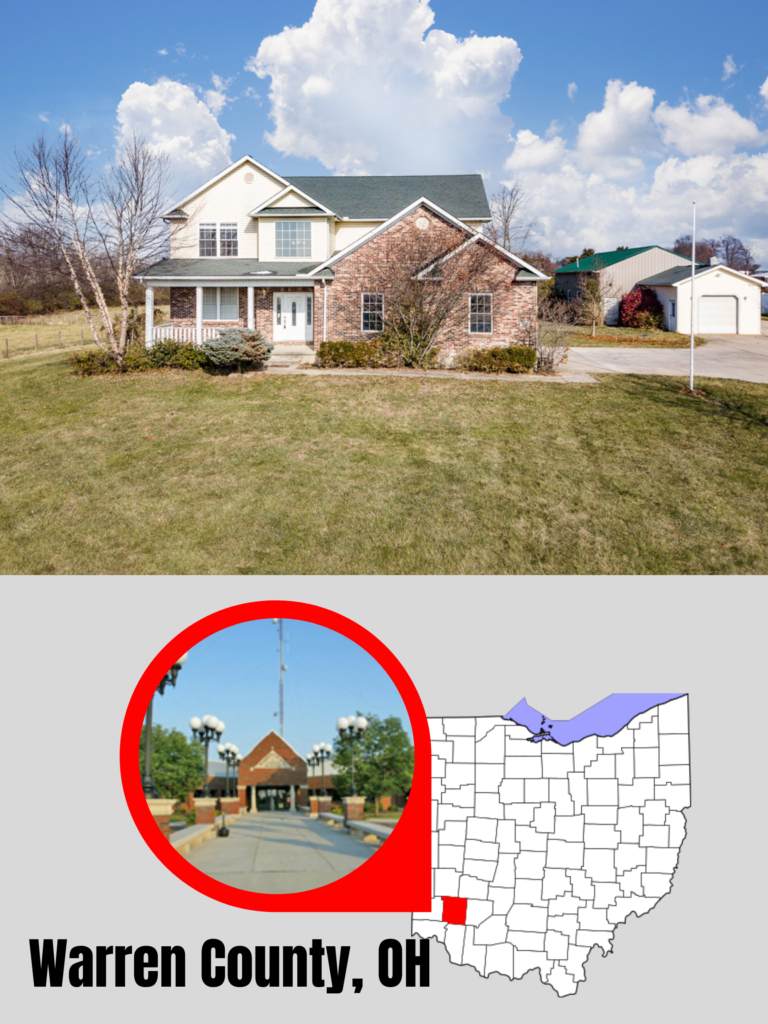
    We’d been following up with him regularly for months, so he knew exactly who to call when his home was put up for auction through the Sheriff (read more about how this happens directly at the Warren County website here). It was a warm Friday afternoon when he called us to see if we were still interested in purchasing his home. Tony answered the phone and assured him that yes, we were still very interested in buying the house. It was at that point that we discovered the house was scheduled to hit the auction block on Monday – the upcoming Monday, only THREE days away, at 8:00A.M. sharp!

    It was going to take a lot of carefully-placed moving pieces to make it happen, but we were more than ready for the challenge. We called our attorney. We put together our paperwork, met him at the property that afternoon, and got everything signed. We crossed all of our T’s and dotted all of our I’s.

    > Read more about selling a house when going through a Divorce here, then give us a call! <

    Tony was running up to the courthouse at 7:50A.M. that Monday with all of the necessary legal paperwork in-hand. The judge accepted, and we had bought ourselves a little more time to complete the title-work and close. We were by no means out of the woods yet, but we had completed the first (and hardest) step in the process, and we were eager to proceed.

    The next snag we hit was that due to the divorce not being totally finalized, the property was still deeded to both the homeowner AND his ex-wife. We’ve handled that exact situation many times before, so we started tackling that problem after we were done at the courthouse. As it turned out, his ex-wife had left town. Actually, she had left the country entirely! The homeowner wasn’t in close contact with her anymore, so we had to track her down and get her onboard and squared away, too.

    In the end, we were able to make it all work out, and created the best WIN-WIN situation we could for the homeowner, the ex-wife, and our team! Not only did the homeowner walk away with some cash from the sale to us, but he also saved his credit from taking an even bigger hit!

    Wondering How to Sell Your House in Foreclosure? Check this out!

    Download Your FREE Stop Foreclosure Guide Below

    Just put in your name and email, click “Submit” and we’ll email you the Free Guide right away.

    • We never rent, sell, or share your info with anyone. It’s not cool and we hate spam

    • This field is for validation purposes and should be left unchanged.

  • Why Do We Pay Property Taxes?

    Whether you’re a seasoned homeowner, or someone on the hunt for your very first home, you should know what Property Taxes are and why everyone who owns real estate has to pay them.  Read on to find out what can happen if you don’t pay your Property Taxes on time.

    If you’ve been renting for a long time, it might come as a surprise to you that Property Taxes are a fairly significant constant and recurring expense that you need to factor in when on the hunt for your first home purchase. On the flipside, if you’re a landlord, you know very well how much you’re spending per month on Property Taxes on any of your properties. 

    Note to renters: Yes, some landlords may be greedy, and inflate your rent amount each year by much more than is reasonable; however, keep in mind that the costs for owning and maintaining housing rise every year with the normal pace of inflation, AND often experience small spikes due to local tax adjustments or special assessments. Most landlords are just trying to keep up with the bills.

    Taxes, as a whole, serve to fund various parts of society that are public services rather than private businesses. Since these various services don’t have a traditional business structure with a stream of revenue from selling goods or services, the public provides that source of revenue directly via various taxes. Essentially, when you pay a tax, you’re paying to keep your city, county, state, and country up and running. There are a variety of taxes that are charged against many different types of transactions and circumstances, which you can easily see an example of if you look at the bottom of your receipt from the department store (sales tax). 

    Learn More About How Our Process Works!

    What’s interesting about city, county, and state taxes, is that they can vary wildly from one place to the next. This is due to the different needs each place has, and what each population deems most important. You might find that a particular city has much higher sales or income taxes than its neighbor, because the city has allocated more funding in its budget towards infrastructure maintenance, or towards keeping the main public areas of the city extremely clean and well-manicured with fresh landscaping throughout the year.

    Property taxes are used to fund a host of local public needs, including the fire department, police department, libraries, road construction and maintenance, the local school district, and much more. They serve as a vital source of funding to keep these services alive, and when revenue dips, those services may suffer as a result. Cities may struggle with making decisions on their budgets each year if that happens, and may be forced to make tough choices in reducing access to essential public services. If you’ve ever heard of schools not being able to afford enough supplies for their students, or about them cutting bus routes out, it’s often because they aren’t receiving enough public funding to pay for everything and everyone that they need.

    How is the Property Tax on your home calculated?

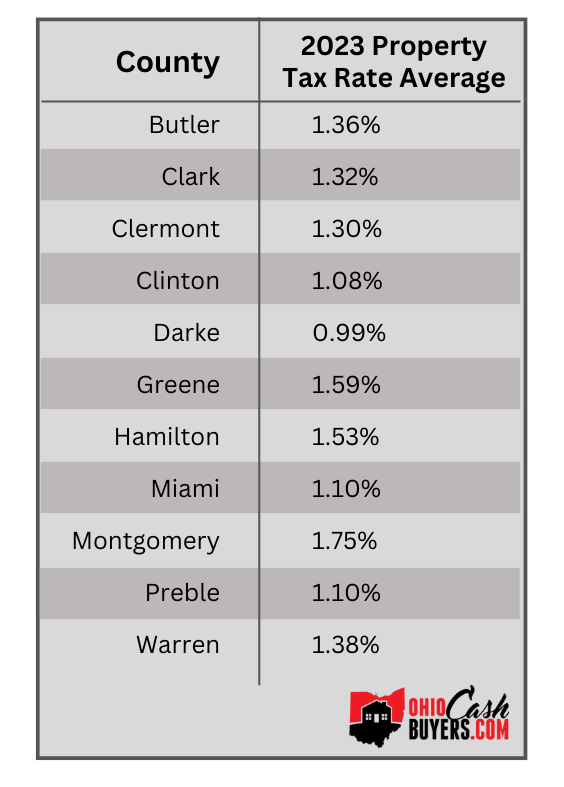
    The County dispatches a specialized tax assessor to determine the fair and current market value of your home (usually this happens every couple of years, unless a purchase/sale of the home is completed to trigger a more immediate request for an updated value assessment). Once the value has been determined, the County is then able to assess Property Taxes against that value as a percentage. As mentioned earlier, the tax rate varies from one County to the next.

    Let’s take a look at the Counties we regularly buy houses from to better show you some differences:

    If you live somewhere in Dayton (anywhere in the metro area that falls within Montgomery County), you’re looking at a much higher Property Tax Rate than the rest of Southwestern Ohio.

    So what happens if you cannot pay your Property Taxes?

    Life happens sometimes, and you can fall behind on paying your taxes. At this point, the home is placed in a “Delinquent Taxes” status, and the County attempts to collect payment from you, with penalties and late fees added on top of your original bill. There is a window of time that you can pay these past due property taxes off and remain in good standing with the County (one calendar year). 

    However, once that window of time has passed, you will lose all rights to your home, and it will be sold out from underneath of you to satisfy the tax debt. Don’t let that happen to you! If you’re behind on paying your Property Taxes and it’s possible that you won’t get caught back up on them, you need to call us NOW to discuss your options to sell your home and avoid foreclosure. Even if you’re just seeking some information and you don’t seriously think you’ll need to sell your home, you should definitely still talk to us. We have a wealth of knowledge and experience in these situations, and we’re happy to help in any way that we can, whether we buy your house or not.

    Call Now! 513-815-5000